AGRicultural Resource-to-Energy Solution

Turn Agricultural Residues into Local Energy

AgriCycle combines feedstock assessment, WTP-X conversion technology and project-specific energy integration for agricultural operations.
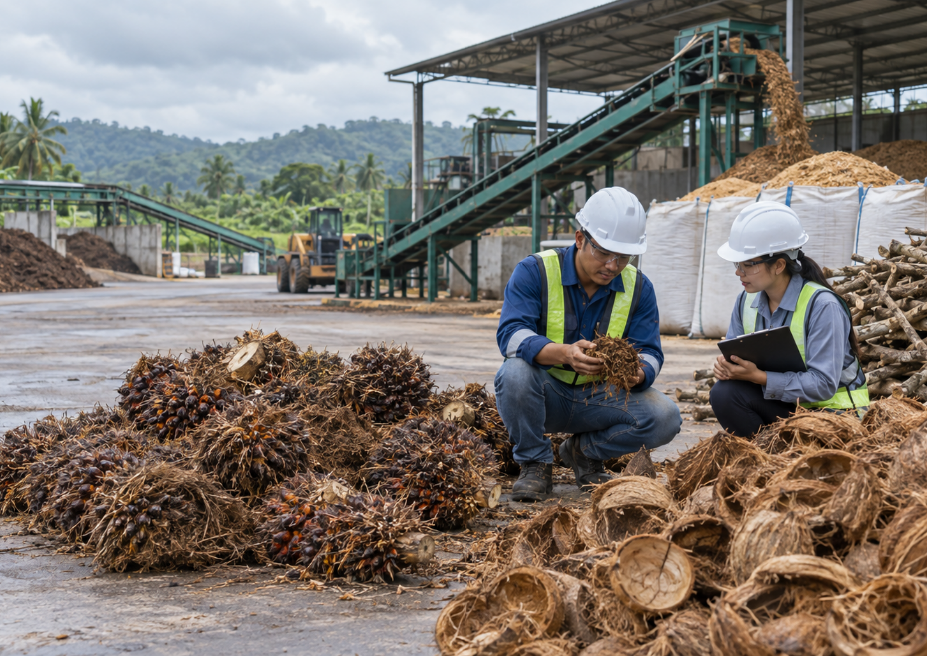
Agricultural Residues Are a Resource Management Challenge

Agricultural operations may face seasonal material volumes, variable moisture, inconsistent particle size and limited local disposal routes.

  • Seasonal feedstock supply
  • Moisture and contamination
  • Storage and handling constraints
  • Remote or unstable energy supply
  • Transport and open-storage pressure

Agricultural resource process

Oil Palm

Palm kernel shells (PKS), empty fruit bunches (EFB), and palm mesocarp fibre. Suitability and pre-treatment requirements are subject to technical assessment.

  1. Oil Palm Plantation & Mill — Oil palm cultivation and milling site where biomass residues are generated, collected and assessed for on-site energy recovery. Electricity and recovered heat can support selected plantation and mill operations.
  2. Residues — Assess each residue stream separately; availability does not establish gasifier suitability.
  3. Feedstock preparation — Configure preparation for particle size, moisture, contamination and handling requirements.
  4. Gasification — Suitable prepared feedstock is converted into producer gas, not directly into electricity.
  5. Gas cleaning & cooling — Clean and condition producer gas before the configured gas engine or other conversion equipment.
  6. Gas engine / generation — A suitable gas engine converts conditioned gas into electricity. Heat recovery is configuration-specific.
  7. Local energy uses — Match local electricity demand and any approved process-heat demand to the engineered configuration.
  • facility → residues: Residue flow
  • residues → pretreatment: Selected residues
  • pretreatment → gasification: Prepared feedstock
  • gasification → cleaning: Producer gas
  • cleaning → conversion: Conditioned gas
  • conversion → uses: Local electricity
Coconut

Coconut shells and dry coconut husks. Feedstock suitability and processing requirements are subject to sampling and technical assessment.

  1. Farm / facility — The selected farm or processing facility where residues are generated and local energy demand is assessed.
  2. Residues — Assess each residue stream separately; availability does not establish gasifier suitability.
  3. Feedstock preparation — Configure preparation for particle size, moisture, contamination and handling requirements.
  4. Gasification — Suitable prepared feedstock is converted into producer gas, not directly into electricity.
  5. Gas cleaning & cooling — Clean and condition producer gas before the configured gas engine or other conversion equipment.
  6. Gas engine / generation — A suitable gas engine converts conditioned gas into electricity. Heat recovery is configuration-specific.
  7. Local energy uses — Match local electricity demand and any approved process-heat demand to the engineered configuration.
  • facility → residues: Residue flow
  • residues → pretreatment: Selected residues
  • pretreatment → gasification: Prepared feedstock
  • gasification → cleaning: Producer gas
  • cleaning → conversion: Conditioned gas
  • conversion → uses: Local electricity